Child development is not just a checklist of best practices. Since the COVID-19 pandemic, several public health reports in Europe have noted a marked increase in anxiety and depressive disorders among children and preteens. Isolation, increased screen time, and family insecurity are among the identified factors.
In light of this observation, recommendations are evolving: emotional regulation and parental psychoeducation are now placed on the same level as nutrition or play in supporting development.
Parents’ Sleep and Child’s Emotional Development
Much is said about children’s sleep, but rarely about that of parents. Recent work in developmental psychology, published notably in the journal Sleep Health in 2022 by a team from the University of Illinois, documents a direct relationship between the quality of parents’ sleep and the socio-emotional development of the child.
The mechanism is quite concrete. A parent suffering from sleep debt exhibits a higher level of stress, reduced emotional availability, and more conflicts within the household. The child, even at a very young age, perceives this tension. Their emotional security is thus weakened, regardless of the time the parent spends with them.
This relationship is bidirectional: a child who sleeps poorly disrupts parental sleep, which degrades the quality of interactions the next day. To access Parlons Enfance for children and explore resources on these family dynamics, it may be useful to combine several approaches. The vicious cycle is not broken solely by addressing the child’s bedtime but also by protecting the rest of the adults around them.

Co-Regulation of Emotions Through Voice, Gaze, and Touch
Developmental neuroscience provides precise insights into what truly stimulates a child’s brain between the ages of 0 and 3. The American Academy of Pediatrics, in its reports published between 2019 and 2023, clearly distinguishes direct human interaction from exposure to screens, including those labeled “educational.”
Co-regulation of emotions occurs through three simultaneous sensory channels: voice, gaze, and touch. When a parent modulates their voice to soothe an angry child, maintains eye contact during a difficult emotion, or places their hand on a frustrated child’s shoulder, they activate neural circuits that screens do not engage.
Why Educational Screens Do Not Replace Interaction
A screen delivers visual and auditory information but does not provide a real-time adjusted response to the child’s emotional signals. The child needs a human response synchronized with their internal state to learn to regulate their emotions. This synchronization does not occur in front of a tablet.
The available data do not allow for setting a universal threshold of screen time suitable for every age. Research converges on one point: the time spent in direct interaction with an attentive adult produces measurable benefits in emotional development that screens do not replicate.
Child’s Emotional Regulation: How Parenting Practices Make a Difference
Learning emotional regulation does not happen through abstract explanations. A three-year-old does not understand being told “manage your emotions.” They learn by observing how the adult manages theirs and by being supported during their own emotional outbursts.
Several concrete elements facilitate this learning:
- Naming the emotion observed in the child (“you are angry because your toy broke”) rather than minimizing or prohibiting it, which gives them usable emotional vocabulary
- Offering a simple physical strategy (breathe slowly, squeeze an object, sit in a quiet place) instead of asking them to “calm down” without tools
- Maintaining the same response to the same situation, day after day, so that the emotional environment remains predictable and the child can anticipate the adult’s reaction
The Role of Consistency in the Child’s Trust
A child who receives a soothing response one day and an irritated response the next for the same behavior cannot build stable reference points. Consistency matters more than the perfection of each interaction. A tired parent who maintains a predictable framework offers more security than a rested parent whose reactions vary according to mood.
Field feedback varies on the relevance of certain methods (quiet time, calm-down corner, etc.). What seems constant in research is that the attentive presence of the adult during the emotional peak produces more effects than any technique applied mechanically.
Child Autonomy and Free Play: A Balance to Find According to Age
Autonomy is not decreed; it is built in stages. A two-year-old choosing between two t-shirts exercises the same decision-making skill as an eight-year-old organizing their backpack. The difference lies in the scope of choices that the adult delineates.
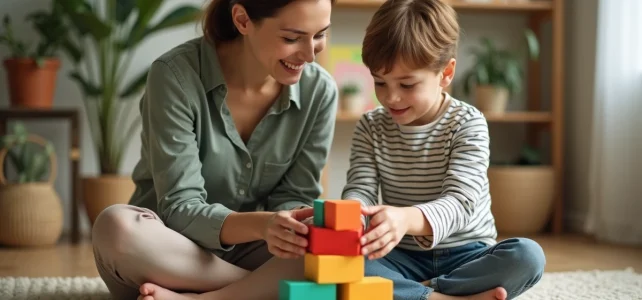
Free play, without instructions or goals imposed by the adult, plays a documented role in developing creativity and problem-solving skills. Unstructured play stimulates abilities that structured activities do not engage in the same way: improvisation, negotiation with peers, managing frustration when a construction collapses.
This does not mean that structured activities are useless. A schedule packed with classes and workshops leaves little room for boredom, which remains a powerful trigger for initiative in children.
Supporting a child’s development relies less on the accumulation of stimuli than on the quality of a few key interactions: protected parental sleep, synchronized emotional exchanges, a predictable framework, and unstructured time. These levers, taken together, shape an environment where flourishing becomes possible without excessive educational pressure.