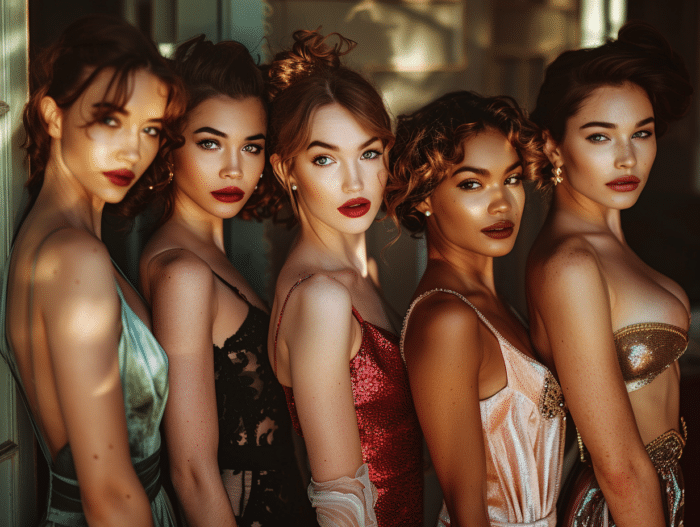
The Hollywood film industry, since its inception, imposes its aesthetic standards, often narrowly defined, that shape the perception of beauty on a global scale. These standards, reflected in the measurements of actresses who grace the big screen, evolve over time, influencing the expectations and aspirations of the public. A thorough examination of these criteria reveals not only the prevailing trends of slimness or voluptuousness but also the social and professional pressures that actresses must conform to in order to succeed in this competitive and often ruthless environment.
Beauty standards in Hollywood: between myth and reality
The beauty norm established by the Hollywood film industry operates like a sometimes distorting mirror of our society. While examples of celebrities with idealized proportions abound, let us mention, for instance, Emily Ratajkowski whose height and measurements epitomize these standards. This aesthetic, consecrated by generations of filmmakers, oscillates between admiration and criticism, between the desire for imitation and the need for more authentic representations.
This paradox does not stop at the female gender. Figures like Johnny Depp testify that even men, if they deviate from established criteria, can be excluded or marginalized within this same system. Natalie Dormer’s recent stance, criticizing the reification of actors and actresses, only underscores this reality.
Cosmetic surgery, often seen as a response to the industry’s demands, raises important ethical questions. Surgical interventions, although normalized in certain circles of Los Angeles, are both an adaptation and a resistance to a cultural policy where appearance often takes precedence over being. The phenomenon raises questions about the place of authenticity in a world where the art of beauty seems inextricably linked to artifice.
The history of these standards, inseparable from the evolution of societies and cinema, remains a backdrop against which the struggles for diversity and inclusion stand out. These battles, fought by courageous actors and actresses, are crucial in shaping an industry that is more representative of the variety of human forms and gender identities. The road to true change is complex, but the voices rising against stereotypes provide evidence that the myth can, little by little, give way to a more nuanced reality.

The diversity of body shapes on screen: progress and challenges
The diversity of body shapes in cinema is slowly asserting itself, marking an evolution in the representation of women and men on screen. The hit series ‘Game of Thrones’, in which Natalie Dormer stars, has notably highlighted strong and complex female characters, breaking away from the monolithic beauty model of the 20th century. Yet, Emma Thompson’s critiques of ageism and sexism persist, reminding us that roles for mature actresses remain sadly limited and stereotyped.
Regarding male representation, the concept of toxic masculinity studied by Dr. Esther De Dauw is gaining visibility. This notion suggests that the pressure on men to meet strict criteria of masculinity fuels harmful stereotypes for all genders. The difference in how the media shapes the image of men and women becomes a fertile field of study for deconstructing these norms and promoting a more inclusive approach.
The globalization of the film industry also has a say in the dissemination of these aesthetic standards. From Paris to Los Angeles, cultural exchange offers an opportunity for varied beauty models to meet and coexist. Despite this, the path toward universal acceptance of diverse body shapes remains fraught with obstacles, a testament to social and political struggles that far exceed the realm of art and cinema.